Barbault's Basket and the Leap We're Being Asked to Make
What a French astrologer and a 1974 psychology paper are both telling us about this moment

Photo by Kid Circus on Unsplash
There’s a hot topic of discussion in astrology circles right now: Barbault’s Basket. Some astrologers are calling it the most important transit of the century. There’s a lot of extraordinary astrology for the times we’re living in right now, but this one has really caught my attention because of its similarities to another topic that’s dear to my heart, Clare W. Graves’ Spiral Dynamics. I used this framework in my 2019 book, The Change Code: A Practical Guide to Making a Difference in a Polarized World. I’ll come back to that in a minute. First, let’s talk about Barbault’s Basket.
What is Barbault’s Basket?
It’s a significant astrological configuration, named after André Barbault, a visionary French mundane astrologer and author of more than 40 books, includingPlanetary Cycles: Mundane Astrology.
Thanks for reading! Subscribe for free to receive new posts and support my work.
Mundane Astrology is the oldest branch of astrology. It comes from the Latin word mundus, meaning “world.” Instead of focusing on individuals, it looks at the astrological charts of nations, cities, and global events.

Photo André Barbault: IsidoreHendrix, CC BY-SA 4.0, via Wikimedia Commons
Who was André Barbault?
Born in 1921, Barbault spent decades studying the relationships between planetary cycles, psychology, and geopolitics. His primary tool was something he called the Cyclic Index, a single number derived from measuring the angular distance between every pair of the five outer planets, Jupiter, Saturn, Uranus, Neptune, and Pluto. When that number drops low, the outer planets are clustered tightly together in the sky. When it climbs high, they’re spread out.
He Predicted COVID and Other Significant Events
Across centuries of data, Barbault found that low points on the index lined up again and again with periods of collective crisis: the Black Death in 1347, the Great Plague of London in 1665, the Spanish Flu in 1918, and the AIDS crisis in 1982.
In June of 2011, at 89 years old, Barbault published an essay naming a specific window, 2020 to 2021, as the lowest point of the Cyclic Index for the entire 21st century. He named the exact mechanism behind it, the Jupiter-Saturn-Pluto conjunction due to occur in January 2020, and he used the word pandemic, not crisis, not difficult period, an actual pandemic. That essay sat in print for nine years before COVID-19 arrived. Barbault died in October of 2019, three months before the world would find out he was right.
This is the same body of work, and the same method, that produced his prediction of the configuration now known as Barbault’s Basket, a turning point he identified decades ago as falling around July 19 to 21, 2026.
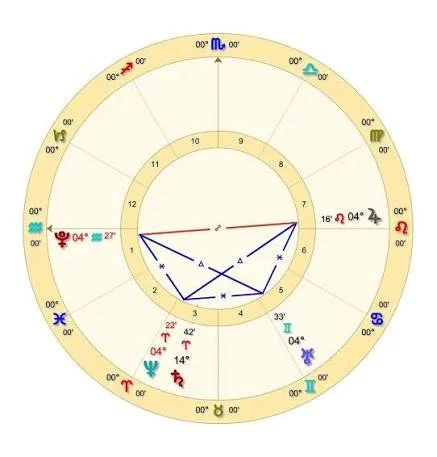
Barbeault’s Basket
The astronomy behind it
Barbault’s Basket is the rare formation of harmonious aspects created when Jupiter in Leo, Uranus in Gemini, Neptune in Aries, and Pluto in Aquarius cluster together in one section of the zodiac, while one planet sits apart to form the geometric pattern he named a basket.
This particular basket is anchored at four degrees, with Jupiter in Leo opposing Pluto in Aquarius, Neptune in Aries sextile Pluto and trine Jupiter, and Uranus in Gemini sextile Neptune and trine Jupiter. All of it builds on the Saturn-Neptune conjunction at zero degrees Aries from earlier this year, which many astrologers see as the seed of this whole cycle. It sits within the broader rise of the Cyclic Index now underway, the same measurement that flagged the 2020 low point. Barbault believed we’re moving out of that low and into a rising curve, one he expected to keep climbing through 2028.
Cyclic Index versus the Basket
It’s worth clarifying a specific point here. The Cyclic Index is the number, the curve that rises and falls across centuries and tells you whether the outer planets are clustered or spread out at any given point in history. That’s the tool Barbault used to flag 2020 to 2021 as a crisis window. The Basket is something more specific: a geometric pattern within a chart, where several outer planets bunch together on one side of the zodiac while a single planet sits apart, forming what looks like a handle.
A low Cyclic Index reading often coincides with basket-shaped clusters since both describe planets crowding together. But a basket can appear on the rising side of the curve too, the way this one does. This basket isn’t signaling another low point like 2020. It’s arriving as the index climbs back up, which is part of why Barbault read it as a turning toward renewal rather than another crisis.
In his own words
Here’s how he put it in his own words, writing about this exact configuration in Planetary Cycles: Mundane Astrology:
“The next conjunction in 2026 is centrally placed at the beginning of Aries and is in a triangular quartet of planets with a double sextile to a trine between Uranus in Gemini and Pluto in Aquarius. It is the most benefic configuration of the century and its interplanetary partnership will work for the best in a splendid relaunch of civilization. It contains a harmonious relationship between primordial opposites; the coming together of the external and the internal, rational and spiritual, mind and soul...human beings surpassing themselves while experiencing life on a higher level.”
That’s a big claim from a man whose track record earns him the benefit of the doubt. Barbault names three things coming together here:
the external and the internal,
the rational and the spiritual, and
the mind and the soul.
For most of modern history, we’ve treated these concepts as opposites. What he’s describing is them finally meeting to work together instead of competing.
Rational and spiritual, meeting in the middle
You can actually see this in the chart itself. Uranus, the planet of the rational mind, sudden insight, and breakthrough thinking, is in a harmonious sextile to Neptune, the planet of spirit, intuition, and the soul’s longing for something beyond the material.
In classical terms, a sextile is an aspect of opportunity, not tension. It opens a door between the planets. That’s the astrological signature of exactly what Barbault is describing in words: the rational mind and the spiritual self no longer at odds, but able to walk through the same door if we choose to take it.
Individual meaning meets collective power
Then there’s Jupiter in Leo trine Neptune and sextile Pluto, and Pluto in Aquarius opposing Jupiter. Jupiter is expansion, meaning, and the individual’s sense of purpose. Pluto in Aquarius is collective power, technology, and the structures that hold entire societies together. When Barbault talks about “human beings surpassing themselves while experiencing life on a higher level,” this is the geometry behind it. Individual meaning and collective transformation are in conversation with each other here.
A wider vantage point
What I believe Barbault is pointing to is a genuine shift in collective consciousness, not a single event we’ll wake up and recognize on the morning of July 20th, but a door that opens and stays open for a while. A move toward more harmony between polarities we’ve treated as enemies for generations: left and right, science and faith, doing and being, the individual and the collective. Not because the differences disappear, but because we get access to a wider vantage point that can hold both at once instead of forcing a choice between them.
That idea, a higher vantage point that can hold what used to feel like opposites, is exactly where this connects to something I’ve been thinking about for years.
What this actually means for you
This isn’t just a collective event happening out there. These same planetary degrees are activating specific houses in your own chart right now, which means the themes land differently depending on your placements.
Here’s what each planet is asking of us
✦ Jupiter in Leo asks about creative confidence and heart centered leadership. Where are you ready to lead as yourself, rather than playing a role someone else wrote for you?
✦ Pluto in Aquarius asks about power and systems. Which structures in your life or community are ready to be rebuilt?
✦ Uranus in Gemini asks about the stories you carry. Which beliefs need updating, and where might that disruption actually set you free?
✦ Neptune in Aries asks about spiritual action. How can you act on what you say you believe, with clear boundaries and real follow through?
Leadership, systems, information, and spiritual action are all moving at once here. The sky isn’t asking us to hold onto what’s been. It’s asking us to step into a different architecture for how we live and work together.
Where this connects to Clare Graves

Clare W. Graves
Now let’s come back to the work of Clare W. Graves that I referenced earlier. Clare W. Graves was a professor of psychology and originator of the emergent cyclical theory of adult human development, aspects of which were later popularized as Spiral Dynamics.
In 1974, Graves published an article in The Futurist called “Human Nature Prepares for a Momentous Leap”. It came out of 20 years of his research into how human values change over time, and it described something that sounds remarkably like what Barbault was pointing to from an entirely different discipline.
Graves predicted that we’re moving toward a new stage of human evolution, a higher level of consciousness that he called “a momentous leap” and a second tier paradigm shift for human kind. Paradigm shifts have happened throughout history, and each one gives us a whole new way of seeing the world. Written in 1974, his description of the transition could just as easily be describing where we are in America today. People on opposite sides of our political divide might agree that something is breaking down, but they explain why in completely different ways. That gap in understanding is a big part of why our society has become so polarized, and it’s the exact reason I wrote The Change Code. I wanted to give people a framework for understanding why we see the world so differently, without writing each other off.
In his own words
Rather than framing this as a breakdown, Graves saw it as something else entirely. In his own words, “it is not so much a collapse in the fiber of man as a sign of human health and intelligence. Man is learning that values and ways of living which were good for him at one period in his development are no longer good because of the changed condition of his existence. He is recognizing that the old values are no longer appropriate, but he has not yet understood the new.”
He went on to say, “The present moment finds our society attempting to negotiate the most difficult, but at the same time the most exciting, transition the human race has faced to date. It is not merely a transition to a new level of existence but the start of a new movement in the symphony of human history.”
What this leap actually looks like
So what does this leap actually look like in real life? In The Change Code, I wrote about paradox, the ability to hold two things that seem opposite and know they’re both true at the same time. It doesn’t have to be one or the other.
Graves saw this shift as one of the clearest signs that someone has made the leap. Fear stops running the show. Creativity and intuition move in to fill that space. And instead of defending one worldview against everyone else’s, people start being able to meet others exactly where they are and find common ground, even with people who see the world completely differently than they do.
Two languages, one message
A mundane astrologer working from planetary cycles and a psychologist working from decades of human values research landed on the same conclusion, decades apart, using completely different tools. It’s an interesting convergence of ideas that deserves our attention.
Both Barbault and Graves describe this moment the same way.
Not as a collapse, but as a threshold.
The old structures breaking down are doing exactly what they’re supposed to do, clearing space for something we haven’t fully built yet.
There’s a widening gap between people still centered in old values and people already living from new ones, and that gap is the source of the tension we’re feeling right now, not a sign that something has gone wrong.
This is a choice point, not a guarantee. The astrology doesn’t promise paradise, and Graves didn’t promise humanity would make the leap successfully either.
What both frameworks agree on is that the conditions for a shift are here, and what we do inside that window is up to us.
The invitation is the same from both frameworks. We have an opportunity to step into a higher level of consciousness, both as a society and as individuals.
To do that, we need to notice where we’re still operating from old, outdated systems that no longer meet our needs, and begin imagining and stepping into new ways of living and working.
Where is this landing in your own chart?
If you're feeling this shift most in your work or sense of direction, a career consultation is a good place to unpack it. We can look at exactly where Jupiter, Pluto, Uranus, and Neptune are landing in your chart and what that means for the decisions in front of you. Book a consultation here.
What part of this is landing for you? I’d love to know in the comments.
This piece first appeared on my Substack. Join me there for regular reflections on practical astrology, current transits, and the patterns shaping our lives.
Much love,